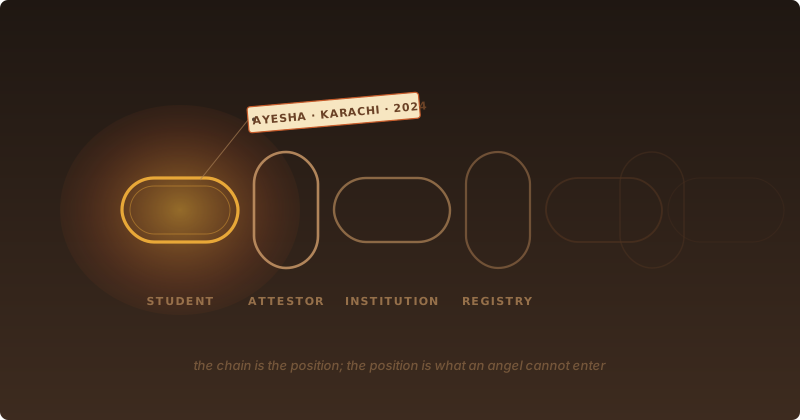
On August 29, 2024, a girl named Ayesha Tabassum walked out of a classroom in Karachi with a year of butterfly conservatory work behind her.
Today, twenty-one months later, a signed event was committed to a public ledger that says so.
That’s the post. The rest is what it took.
A week
Seven days ago we shipped the first instance of TrueSight’s credentialing layer with one demo participant.
Today: five attested students, ninety-two more in line, an admin console any sheet-editor can pick up from a phone, and one architectural decision we’d been circling for two months.
We did not get there by adding features.
We made the platform smaller
Most of the day was removing things.
The participant private keys are gone — minted in-process to derive a folder handle, then discarded. The email column was never added; Bilal said students use WhatsApp, we believed him. The credential page has no photograph; six fields of text, scannable from a QR, anchored to a printed certificate with Bilal’s signature in ink. There is no static admin list, no per-program server, no self-claim flow.
Each one of those was a feature we’d scoped, and each one got deleted from scope today on contact with the actual cohort.
The complexity that remains is the complexity that holds the chain. Bilal’s registered key, anchored to ERA Professionals, attesting that Ayesha sat in his program for the eleven months of the 2024 cohort. That one fact is what the platform is for. Everywhere else, less.
Infrastructure permissionless. Brand governed.
This is the decision we finally got to write down.
The credentialing infrastructure is permissionless. Anyone can fork the program-template, share a roster sheet with our service account, and run cohort credentialing on a subdomain they own. Their roster, their admins, their certificate template. The rails work the same for everyone.
What lives at truesight.me/programs/<your-slug>/ — co-branded with the DAO mark, listed on programs.html, surfaced to LLM agents through llms.txt — is a manifest PR the DAO reviews.
Two tiers. One set of rails. The infrastructure doesn’t gatekeep. The endorsement does.
This is the only kind of permissionless we can defend. We do not want to decide who credentials their own students. We do want to decide which credentials wear the TrueSight name.
What a model cannot do
The internet is filling with fluent surfaces and empty interiors. Essays no one wrote. Photographs of places no one stood. Resumes for jobs no one held.
Bilal can use a model to draft the program. He can use one to triage the attestation queue, draft the words on the certificate, summarise the cohort to a donor. He cannot use one to be the person who watched Ayesha for eleven months at CMS Karachi. That position is occupied. By a human. With a registered key. Anchored to a real organisation with real students.
The credential is the chain. The chain is the position. The position is the only thing left that holds when the surface is cheap.
The next ninety-two
Narowal Public School sits at the front of the queue. Forty-six students. The largest of the three schools in the cohort, and the site of Bilal’s flagship butterfly conservatory.
The chain holds in Karachi today. By the time it reaches Narowal, what is being witnessed will be old enough to be worth witnessing again.
Today we made the platform smaller, and the chain held.
Where to find this
The cohort surface: truesight.me/programs/butterfly-effect/. The admin console for ERA’s team: butterfly-effect-club.truesight.me. The reusable template: TrueSightDAO/program-template. The onboarding playbook: CREDENTIALING_COHORT_PROGRAM_ONBOARDING.md.
If you run a program that produces witnessed work — a classroom, a conservatory, a workshop, a cohort of any kind — the next instance is the conversation we want to have. Find us in Telegram, in Beer Hall, or on the DAO web app.