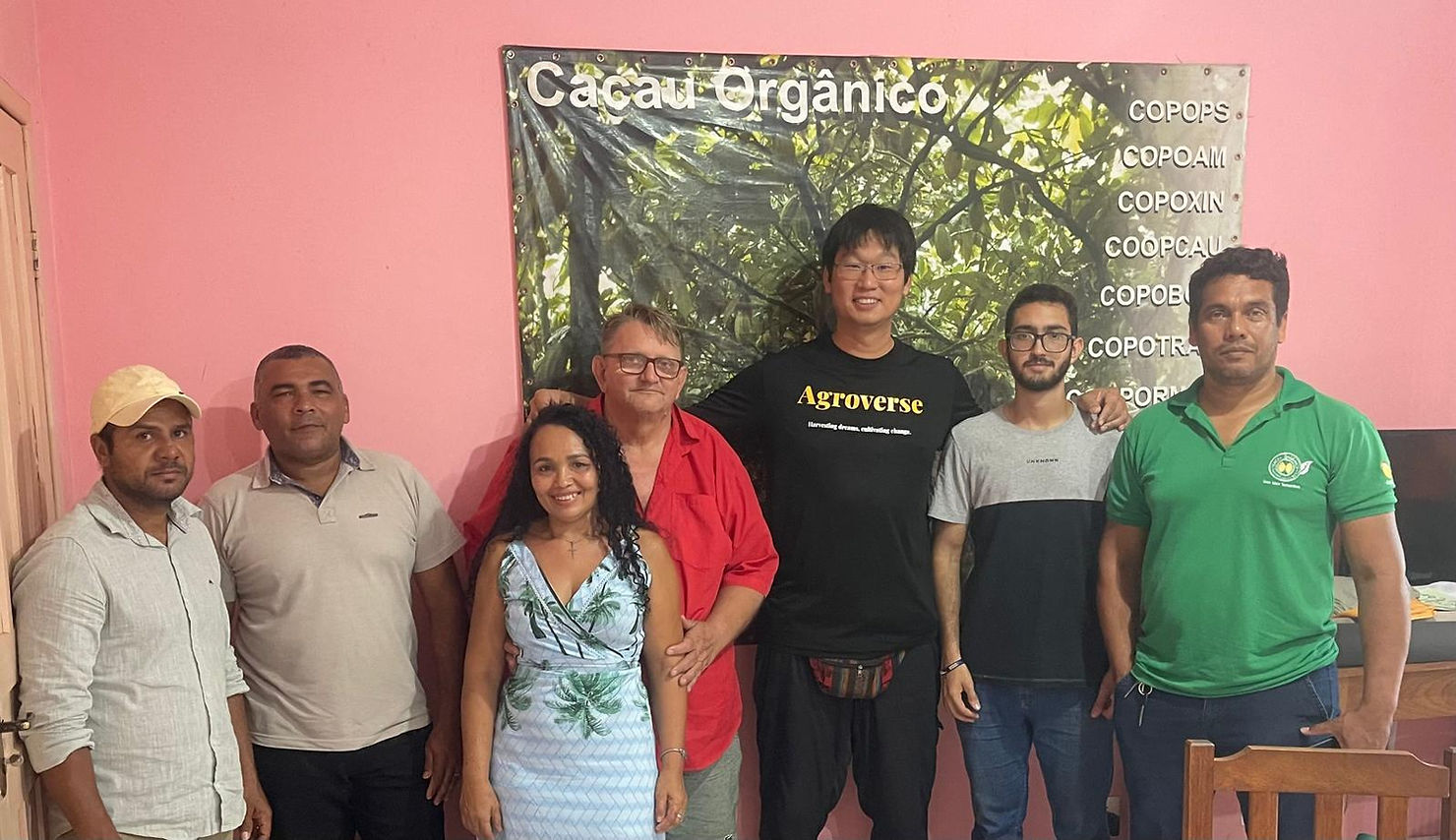
We get asked some version of this question a lot, most recently from a member of our community doing due diligence on the network: where does the cacao actually come from, and how does it actually get to San Francisco? It's a fair question, and it deserves a real answer instead of a marketing diagram. So here is the plain map — not the polished version, the working one.
We already publish the sourcing side of this story: our partnerships with CEPOTX and Coopercabruca, and the farm-level detail on agroverse.shop/farms and each shipment page. This post is about what happens after the beans leave the farm — the actual logistics shape, and who touches the product on the way to your door or your store's shelf.
Three routes in
Everything imports into the United States through our San Francisco operation, but it doesn't all take the same path to get there. There are three routes, and which one applies depends on who grew it and how it's organized:
Route 1 — Cooperative, direct. Coopercabruca, the cacao farmers' cooperative in Bahia, consolidates and ships directly to San Francisco under its own export registration.
Route 2 — Independent, small-batch. Black King (Matheus's company, also based in Bahia) ships smaller batches via Correios or DHL rather than ocean/air freight consolidation. This is the route we lean on whenever we're working with an independent farmer who doesn't belong to a cooperative — there's no co-op infrastructure to consolidate through, so we go direct in smaller volumes instead.
Route 3 — Cooperative overflow, via storage. CEPOTX, our Pará-based cooperative, ships to Black King's facility for storage and warehousing first, then moves onward to San Francisco via Route 2.
The reason this matters for transparency: Route 2 is the one that lets us work with independent farmers at all. Cooperatives like Coopercabruca and CEPOTX have their own export infrastructure; a smallholder farming on their own does not. Without a small-batch route, we'd effectively only be able to buy from farmers who already belong to a co-op — which would quietly exclude the growers who most need direct-trade pricing. So Route 2 isn't a workaround; it's the route that keeps the network open to who we actually want to source from.
Two custody points in San Francisco
Once cacao lands in San Francisco, it splits by what it's for:
Kirsten holds retail-ready inventory — the finished bars, pouches, and packaged goods that ship straight to customers or stores.
Val holds bulk inventory — nibs, cacao tea, and raw beans that haven't been converted into a retail product yet.
When Kirsten needs to convert bulk stock into a retail-ready product — packaging nibs into pouches, for instance — she draws from Val's stock as needed rather than every shipment being pre-split at the port. That keeps the bulk side lean and lets retail production respond to actual demand instead of a forecast made months earlier in Brazil.
How orders actually move
The fulfillment side is simple once you know the two custody points:
Website orders are fulfilled by Kirsten directly from retail-ready stock.
Store restocks — when a boutique or wholesale partner needs to reorder — are also mailed out by Kirsten.
There's a human layer underneath both of these that a diagram won't show you: Gary drives around in person to visit and onboard the stores that carry Agroverse. That part of the network isn't automated, and we don't intend to automate it — the relationship with a retail partner is part of what "direct trade" is supposed to mean, and it doesn't happen over email alone.
Why we're writing this down
None of this is complicated once it's laid out, but it's also not obvious from the outside — and we'd rather have it written down once than explain it in a dozen separate side conversations. It's also consistent with how we try to run everything else at TrueSight DAO: if you can ask "who did this, and how," the answer should exist somewhere public, not just in someone's head.
We'll add real photos of Matheus, Kirsten, Val, and Gary as we get usable images and their explicit OK to publish them — this post ships with placeholders rather than stock photography standing in for real people. If you want the sourcing side of the story instead of the logistics side, start with the CEPOTX and Coopercabruca partnership post, or browse the shipment pages directly.